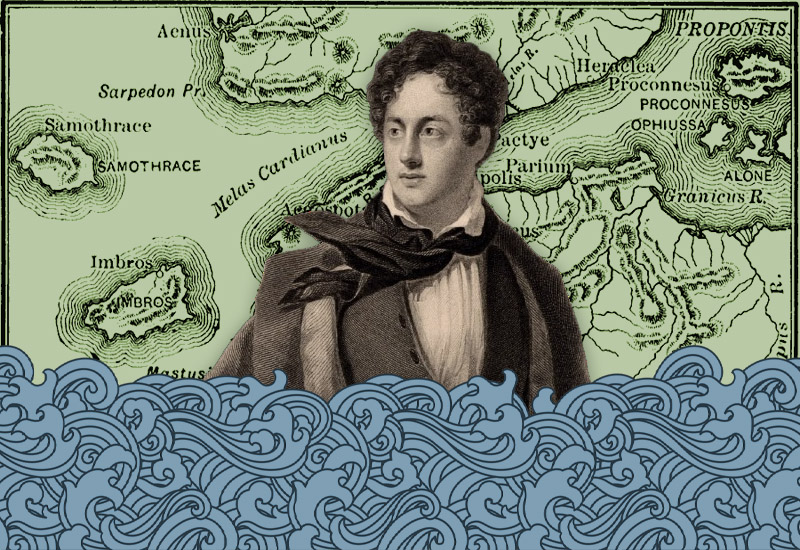
Lord Byron recreated one of antiquity's most famous romantic gestures on May 3, 1810, swimming across the Hellespont in imitation of the mythological Leander. The British Romantic poet undertook the treacherous four-mile crossing of the strait separating Europe from Asia, then called the Dardanelles, to prove the feat possible and to connect himself to the classical legend of doomed passion.
The swim cemented Byron's reputation as a writer willing to inhabit the transgressive figures he celebrated in verse. His obsession with Leander's story had already inspired "The Destruction of Sennacherib" and would later inform "She Walks in Beauty" and other works that romanticized dangerous desire and physical excess. By executing the swim himself, Byron collapsed the distance between poet and persona, transforming his body into text.
The crossing took him roughly an hour in fierce currents. Byron survived, unlike his mythological counterpart, whose nightly swims ended when a storm extinguished Hero's guiding lamp, leaving Leander to drown. The poet's survival added another layer to his Byronic mystique. He had not merely written about transgression and classical heroism. He had embodied them.
This moment arrived during Byron's formative travels through the Levant, journeys that would fuel *Childe Harold's Pilgrimage*, his 1812 masterwork. The eastern Mediterranean landscapes and his firsthand encounters with Ottoman culture shaped the orientalist aesthetics that defined his most celebrated work. The Hellespont swim belonged to that crucial apprenticeship, the moment when Byron learned to weaponize his own biography.
The feat announced what readers would soon discover: Byron's poetry emerged from lived experience, from a consciousness willing to test itself against physical and moral limits. His work refused the separation between author and work that characterized much Romantic poetry. Instead, it demanded readers confront the man behind the verses, his appetites and his transgressions inseparable from the beauty of his lines.
WHY IT MATTERS: Byron's Hellesp