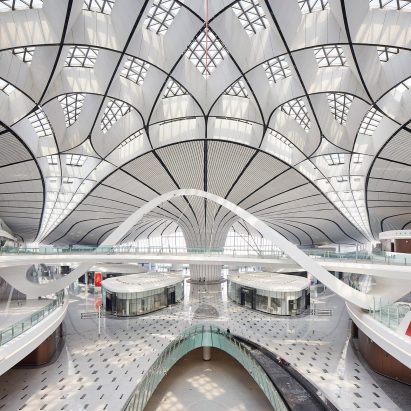
Dezeen has published an introductory guide to parametricism, the 21st-century architectural movement that has sparked debate among designers and theorists since its emergence. The publication frames parametricism as a style rooted in digital design tools and computational methods, positioning it as essential reading for anyone seeking clarity on a notoriously abstract concept.
Parametricism emerged from architects' ability to harness sophisticated software to generate complex forms based on mathematical parameters. Rather than designing buildings through traditional sketches and blueprints, practitioners input variables—structural requirements, environmental factors, spatial needs—and allow algorithms to generate optimized solutions. This computational approach fundamentally shifts how architects conceive space and form.
The style has generated considerable discourse within architecture circles. Advocates praise parametricism's efficiency and its capacity to create buildings responsive to their environmental and functional contexts. Critics contend that the movement prioritizes visual complexity for its own sake, producing designs that feel divorced from human experience. The contention hinges on whether parametricism represents genuine innovation or aesthetic excess enabled by technology.
Dezeen's guide arrives as parametricism increasingly influences major architectural practices globally. Firms like Zaha Hadid Architects and Neri Oxman's design studio have pushed parametric methodologies into mainstream consciousness, delivering buildings that showcase flowing, organic geometries impossible to achieve through conventional design processes.
The architectural press has documented parametricism's evolution closely. What began as a niche theoretical pursuit has penetrated professional practice, influencing everything from urban planning to product design. Yet accessibility remains an obstacle. The concept demands understanding of both architectural theory and computational logic, creating a knowledge barrier for general audiences.
Dezeen's effort to demystify the movement reflects broader publishing trends in design journalism. As digital tools become standard practice, outlets must translate technical concepts for readers navigating an increasingly complex design landscape. The guide serves this pedagogical function while acknowledging ongoing disagreements about parametricism's actual merit and cultural value.
THE TAKEAWAY: Parametricism remains contested territory in architecture, and accessible explanations matter as computational design becomes standard practice.