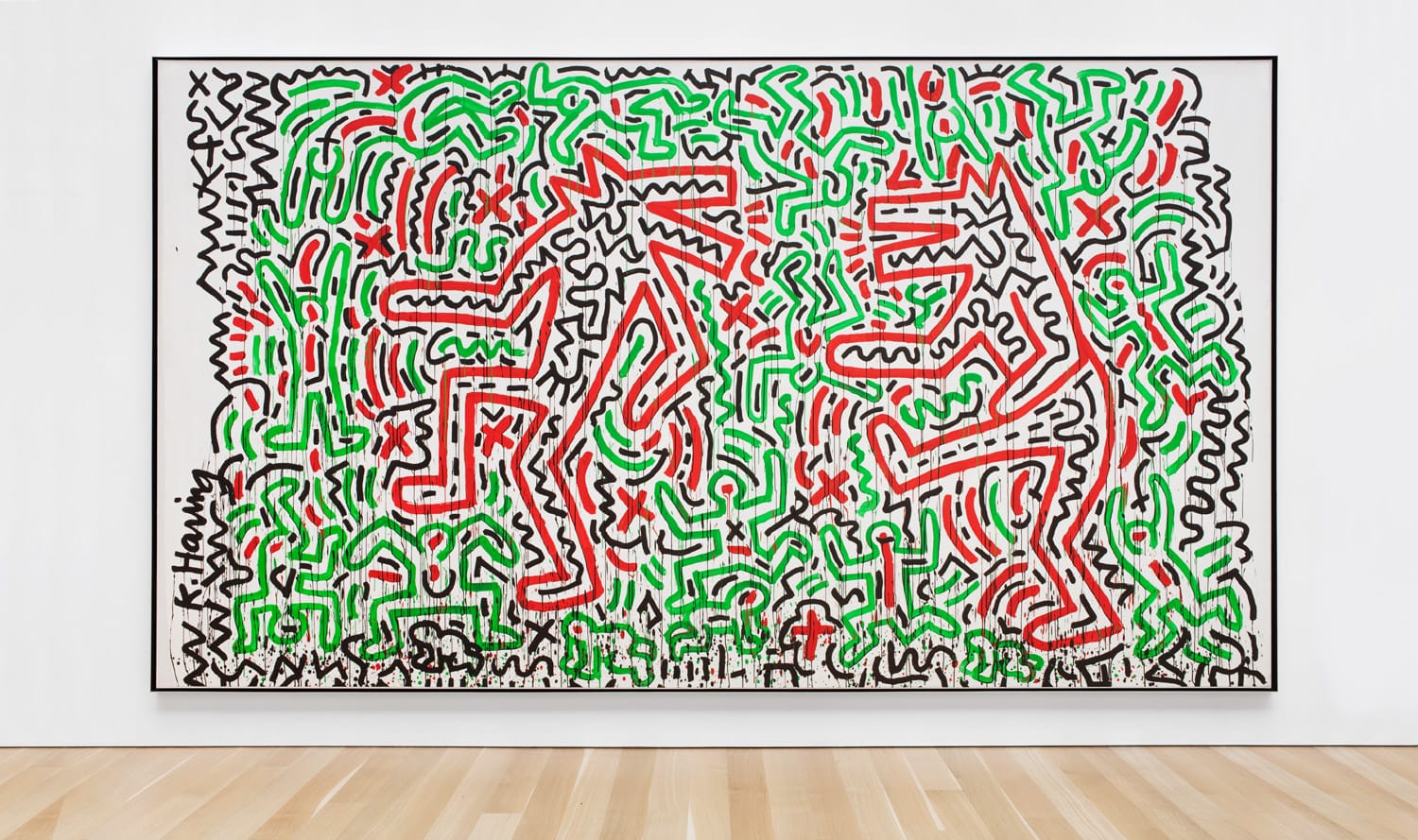
Keith Haring's energetic line work and immediacy emerge with new resonance in "Keith Haring Before the End of the World," a Brant Foundation exhibition that positions the late artist as a prophet of our machine-dominated moment. Haring's gestural abstraction, executed with deliberate spontaneity and human imperfection, reads as an act of resistance against algorithmic sterility.
The exhibition catalogs works that prioritize the artist's physical presence on canvas. Each brushstroke declares a human hand at work. That declaration matters now. As AI image generation colonizes creative industries, Haring's refusal to polish or perfect his forms becomes radical. His figures move with authentic awkwardness. They bleed across boundaries. They resist the smooth, optimized perfection that machine learning produces.
Haring died in 1990, before the internet became quotidian, before neural networks learned to paint. Yet his insistence on speed, intuition, and the mark-making body itself suggests he intuited something essential about art's survival value. His subway drawings in the 1980s existed outside galleries entirely, on walls and tunnels where permission mattered less than presence. He made art to assert existence, not to be catalogued by algorithms.
The Brant Foundation exhibition doesn't explicitly frame Haring against AI, but the curatorial premise allows that reading. "Before the End of the World" invokes apocalypse. The exhibition title acknowledges we live in the shadow of technological transformation, one that threatens human-centered creativity. Haring's work becomes a document of what art looked like when human intention still governed every mark.
This feels less like nostalgia and more like documentation. The show preserves a moment when spontaneity still belonged to artists alone.
THE TAKEAWAY: Haring's immediate, bodily approach to painting gains urgency as AI threatens to standardize visual culture.