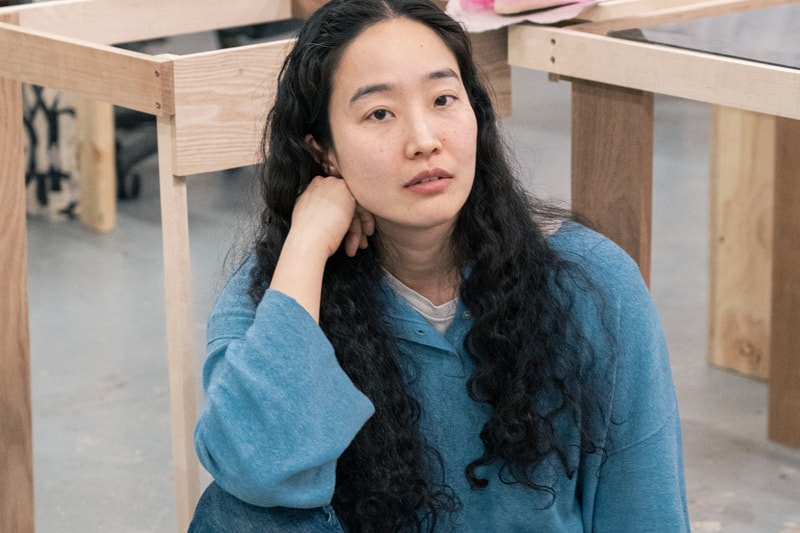
Korean-American artist Hyeree Ro has secured a place at the Venice Biennale, one of contemporary art's most prestigious platforms. Ro's selection marks a significant moment for her practice, which centers on delicate manipulations of organza and beeswax.
In her Brooklyn studio, Ro constructs intricate sculptural works by dipping gold-rimmed organza circles into warm baths of beeswax, then hand-stitching them together into expansive, membranous sheets. The process is meditative and labor-intensive. Each circle begins as a fragile element, but when assembled collectively, the pieces gain structural integrity and visual power. Ro describes this transformation with clarity: "Each circle is small and fragile, but when they're together, they're strong, resistant."
The Venice Biennale represents the apex of global contemporary art exhibitions. Selection reflects not just critical validation but also entrance into an international conversation about artistic practice and direction. For Ro, whose work draws on material traditions rooted in both Italian and East Asian textile cultures, the venue carries particular resonance. Organza itself carries that hybrid lineage, a fabric historically produced across multiple continents and craft traditions.
Ro's approach to materiality operates within a broader contemporary art discourse around process, patience, and the body's labor. Her use of beeswax invokes natural systems and organic transformation, while her hand-stitching emphasizes human craft over industrial production. The resulting works possess both intimacy and scale, inviting viewers into contemplative encounters with texture and light.
The artist's trajectory from Brooklyn studio to Venice reflects how institutional recognition continues to reshape careers in contemporary art. Her inclusion in the Biennale suggests growing curatorial interest in artists working at the intersection of textile traditions, sculpture, and conceptual practice. Ro joins a selective roster of artists shaping conversations about materiality and craft in the twenty-first century.