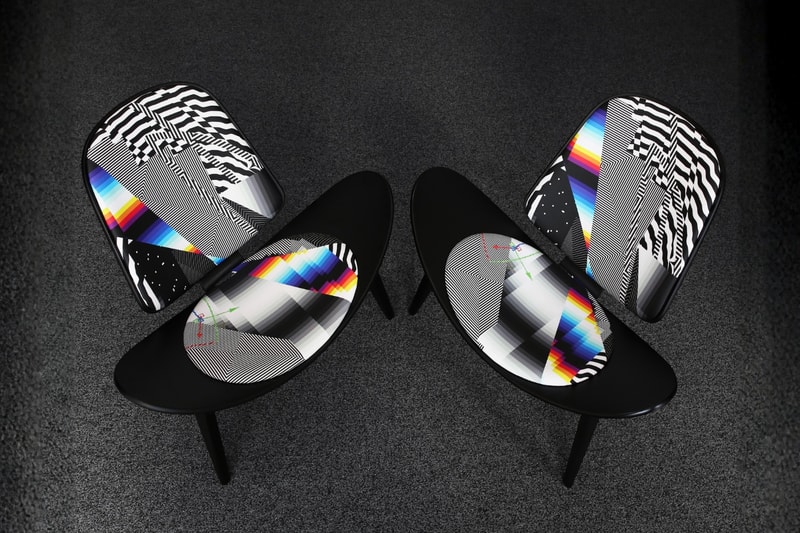
Albertz Benda's Los Angeles gallery opens "Parallel Practices: Tailored Structures & Kinetic Surfaces" this summer, featuring the first major collaboration between street artist and designer Felipe Pantone and emerging fashion designer Etai. The exhibition runs from July 17 to August 8, 2026.
Pantone, known for his vibrant geometric abstractions and color-field work spanning galleries and public walls, brings his signature kinetic sensibility to the project. Etai, a rising voice in contemporary design, contributes her expertise in textile innovation and spatial curation. Together they reimagine mid-century furniture pieces by digitally remapping their forms and reupholstering them with custom fabrics from Limonta, the Italian textile manufacturer renowned for high-performance materials.
The exhibition inhabits Albertz Benda's domestic-scaled Los Angeles space, transforming it into a laboratory where furniture becomes art object. By layering Pantone's geometric language onto utilitarian forms and combining that with Etai's textile sensibility, the show explores how decorative arts can dissolve the boundary between function and formal experimentation.
This partnership reflects a broader trend in contemporary art where street and digital aesthetics increasingly infiltrate gallery spaces and furniture design. Albertz Benda, which represents both Pantone and emerging designers, positions itself as a venue where such cross-disciplinary work finds natural expression. The emphasis on "parallel practices" suggests both artists maintain independent directions while discovering unexpected convergence.
The reliance on Limonta fabrics anchors the project in material specificity. Rather than treating textiles as secondary, the exhibition foregrounds surface treatment as conceptual content. Pantone's color theory meets Etai's understanding of how fabric performs, drapes, and communicates meaning through tactile presence.
For collectors and observers tracking contemporary design's evolution, the show marks a moment where Instagram-era visual culture fully penetrates the domestic object. Pantone's cross-platform success translates here into tactile, inhabitable form. Etai's involvement suggests a generation of designers