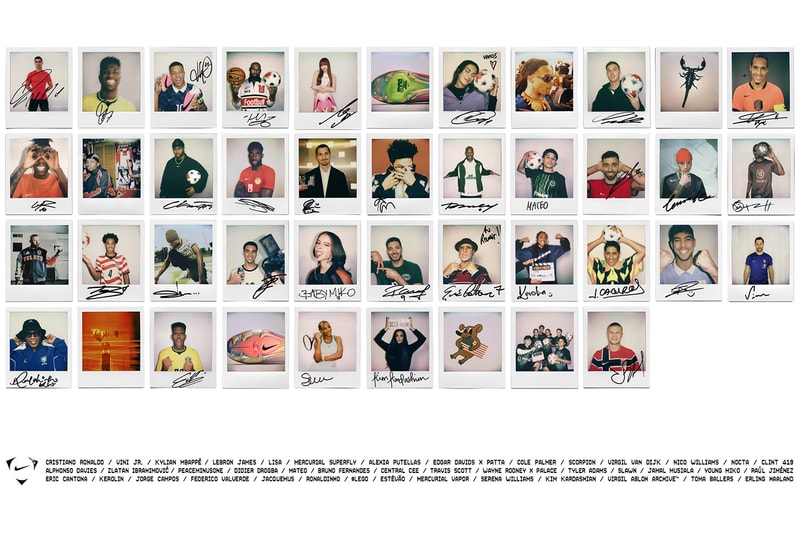
Nike Football has launched its 2026 World Cup campaign with a deliberately unconventional strategy. Rather than deploying the traditional hero film that has defined the brand's major tournament marketing for decades, Nike distributed 42 autographed Polaroids across social media platforms, creating a wall of celebrity endorsements that bridges sports, music, and fashion.
The campaign assembles an unlikely roster spanning multiple industries. Football stars Cristiano Ronaldo, Erling Haaland, and Kylian Mbappé appear alongside Kim Kardashian, Travis Scott, and BLACKPINK's LISA. This cross-cultural approach signals Nike's attempt to position the World Cup beyond the stadium, reaching audiences who may not follow soccer but consume celebrity culture and entertainment content.
The Polaroid format itself carries cultural weight. The vintage aesthetic contradicts Nike's typical high-production value, injecting a scrappy, intimate quality into what amounts to a multimillion-dollar marketing apparatus. Each signed photograph functions as both collectible and advertisement, inviting social media sharing and conversation rather than passive consumption of a scripted narrative.
This campaign structure teases forthcoming World Cup collaborations without revealing them directly. By assembling these figures first, Nike builds anticipation for announced partnerships while maintaining mystery around specific product drops or athlete exclusives. The approach mirrors how social media influencers operate, prioritizing moment creation and shareable content over traditional advertising.
The decision abandons Nike's established playbook of cinematic World Cup campaigns directed by marquee filmmakers. Instead, the brand trusts that celebrity density and cultural relevance will generate organic buzz. This reflects shifting attention spans and platform dynamics, where a curated grid of Polaroids generates faster engagement than a single polished film.
Nike's 2026 strategy suggests confidence in celebrity power's staying power while acknowledging how marketing consumption has changed since previous World Cups. The campaign positions football not as sport alone but as cultural event, stretching sponsorship value beyond the pitch into fashion, music, and lifestyle categories.