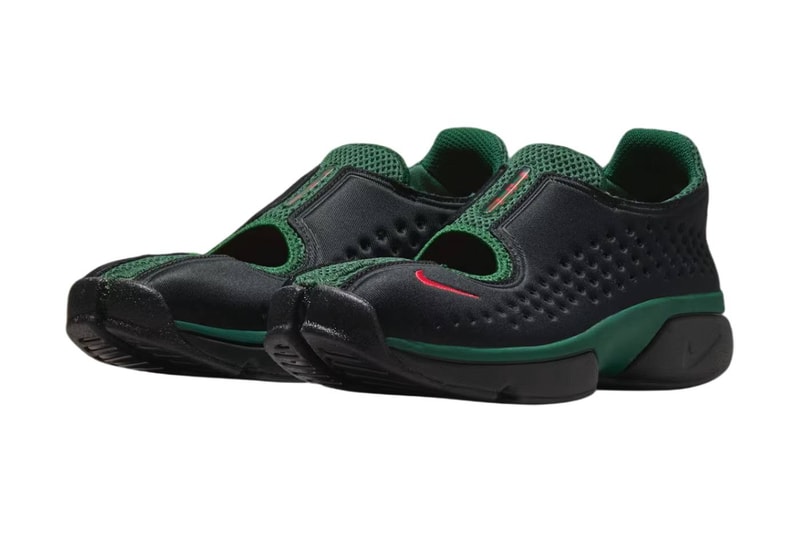
Nike resurrects one of its most unconventional silhouettes this summer. The Air Rift 2 "Kenya" returns in 2026, nearly a quarter-century after its original 2002 debut, arriving in a women's colorway of black, team dark green, and fire red through Nike's SNKRS platform.
The split-toe geometry that defined the Air Rift lineage endures as a distinctive design choice. The original Air Rift launched in 1995 as a minimalist running shoe, stripped down to performance essentials. The Rift 2 evolution preserved that split-toe construction while expanding the silhouette's visual vocabulary. This 2026 reissue signals Nike's ongoing interest in excavating forgotten technical runners from its archives, a trend that has gained momentum as sneaker culture increasingly values innovation-driven design over trend chasing.
The "Kenya" designation carries weight within Nike's running heritage. The colorway anchors the shoe to its performance running roots rather than positioning it as a retro-fashion object. The black base with team dark green and fire red accents creates visual contrast that emphasizes the shoe's geometric split-toe feature, making the unusual construction impossible to ignore.
Nike's retrieval strategy here differs from typical nostalgic reissues. Rather than banking solely on '90s and early 2000s sentiment, the brand frames the Rift 2's return as validation of forward-thinking footwear design. The split-toe concept challenges conventional shoe architecture, which explains both its initial niche appeal and its cult following among design-conscious collectors.
The shoe arrives as Nike navigates competitive pressure from Salomon, New Balance, and other brands mining the technical running archive. Reissuing unexpected silhouettes like the Air Rift 2 serves dual purposes: it differentiates Nike's catalog and reinforces the brand's design legacy to audiences who might overlook it.
Pricing and exact availability details remain unconfirmed, though the SNKRS exclusive approach suggests Nike expects strong demand among its most engaged collectors. The