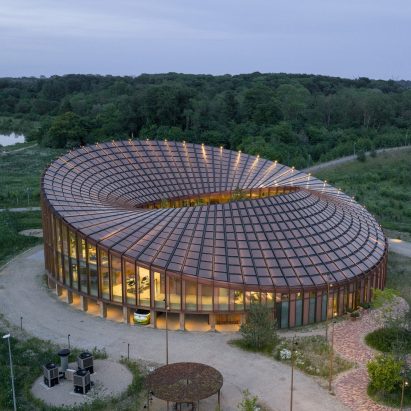
Bjarke Ingels' architecture studio BIG has completed a striking circular headquarters for Dymak, a Danish material supplier, in Odense. The 2,800-square-metre building wraps offices and showrooms around a stepped open-air courtyard, with the structure rising as a rounded mass-timber construction that prioritizes low-carbon building practices.
The most arresting design element is the roof, which references a Möbius strip, the mathematical surface with only one side and one boundary curve. This formal gesture connects the building's form to its material identity, since Dymak supplies materials for construction. The circular plan itself becomes functional rather than merely aesthetic. It organizes workspace and display areas while the courtyard functions as the project's social and operational heart.
BIG positioned the headquarters on a green site overlooking Glisholm Lake in Odense, treating the landscape as integral to the design rather than secondary. The building's rounded geometry and mass-timber construction reflect broader industry shifts toward sustainable architecture. Mass timber, increasingly favored by architects seeking to reduce embodied carbon in buildings, offers structural performance comparable to steel and concrete while sequestering carbon throughout its lifecycle.
Ingels and BIG have established themselves as designers willing to reconcile ambitious formal geometry with pragmatic sustainability concerns. Recent projects including the Telus Garden in Vancouver and Google's Bay View campus demonstrate this consistent approach. The Dymak headquarters extends this philosophy while serving a client whose business intersects directly with material innovation.
The stepped courtyard design likely provides weather protection while maintaining visual and spatial openness, allowing employees and visitors to experience the building's circular logic from within. This arrangement transforms what could have been a purely symbolic form into operational architecture that generates daily use patterns reflecting the building's geometric organization.