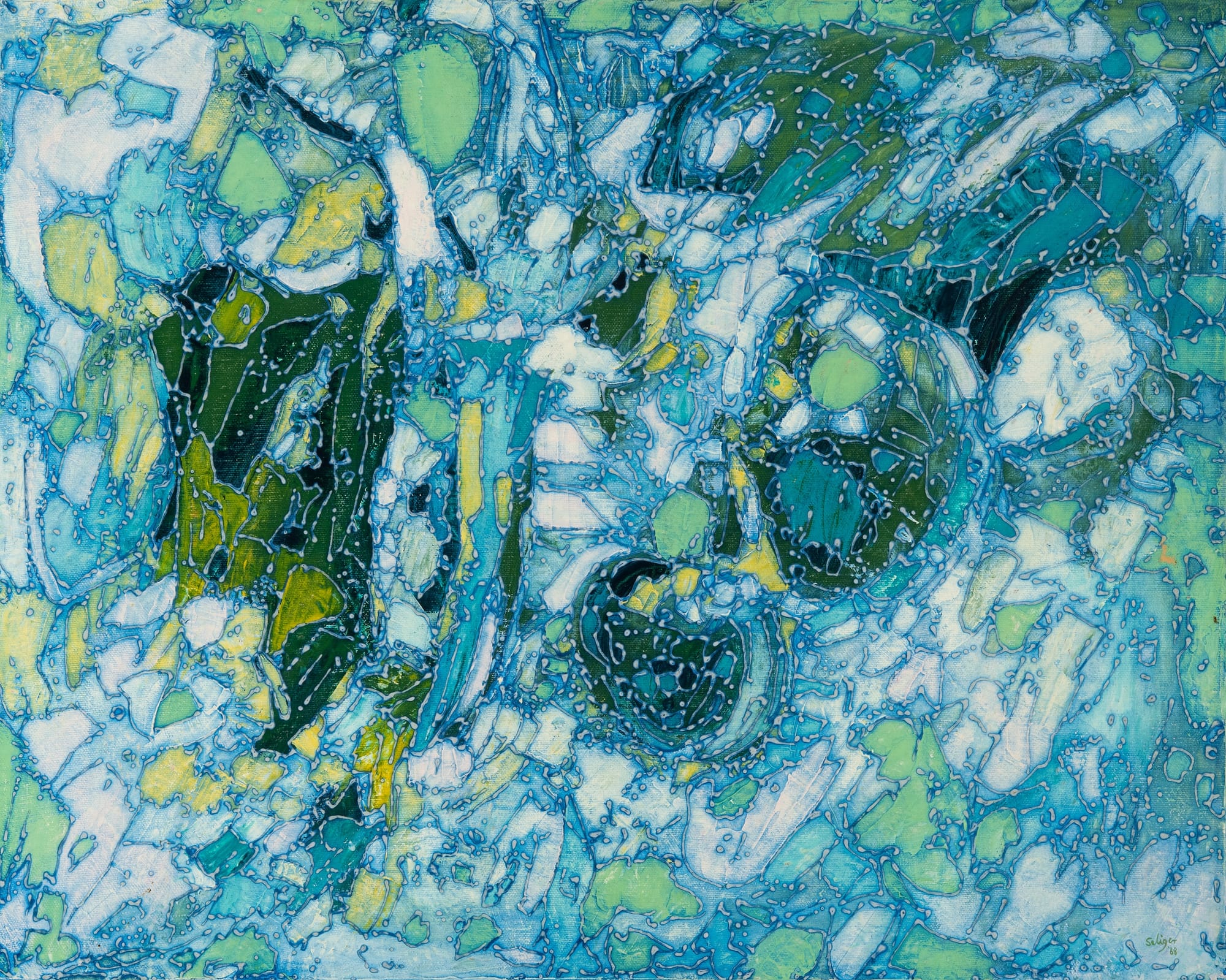
Charles Seliger emerged as one of Abstract Expressionism's most distinctive voices by pursuing a vision rooted in scientific observation rather than gestural abstraction. While his contemporaries embraced the explosive brushwork and emotional intensity that defined the movement, Seliger charted a different course, translating the invisible architecture of cellular and organic structures into visual form.
Born in 1926, Seliger gained recognition early, becoming one of the youngest artists associated with Abstract Expressionism. Unlike the movement's canonical figures, he rejected pure abstraction divorced from nature. Instead, he studied biological forms, microscopic organisms, and natural growth patterns, then rendered them through his own distinctive visual language. His paintings reveal intricate networks and pulsating forms that suggest life at scales invisible to the naked eye.
This approach positioned Seliger as a bridge between scientific inquiry and artistic expression. His work anticipated contemporary interests in biomimicry and the aesthetic dimensions of scientific visualization. Where de Kooning and Pollock mined the unconscious through paint, Seliger mined the rational world of nature itself, finding in it endless complexity and beauty worthy of aesthetic investigation.
Seliger's independence within Abstract Expressionism proves historically significant. The movement often appears monolithic in retrospect, dominated by the myth of the heroic American male artist. Seliger's career reveals the movement's actual diversity. He pursued color and precision, organic rather than gestural abstraction, and sustained engagement with observation rather than spontaneity.
His relatively modest place in the canon reflects not aesthetic shortcoming but historical accident. As Abstract Expressionism narrowed into mythic narratives of action painting and machismo, artists like Seliger receded from view. Recent years have seen renewed interest in recovering these overlooked figures, recognizing how they expanded the movement's possible directions.
Seliger's legacy invites reconsideration of Abstract Expressionism itself. The movement encompassed more than received accounts suggest. His paintings remain visually compelling testimony to the artist's conviction that nature's intricate systems offered inexhaustible material for artistic exploration.