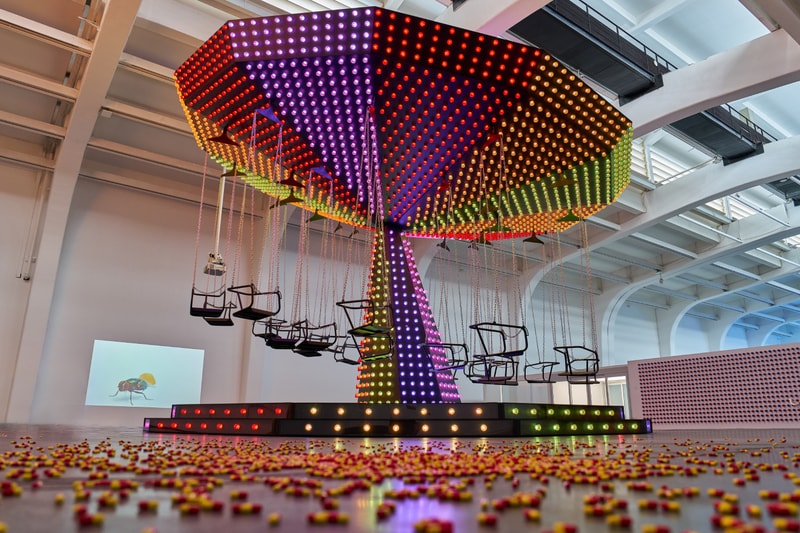
German artist Carsten Höller has opened "Two" at UCCA Beijing, his first major solo exhibition in China. The show runs through January 31, 2027, and transforms the museum's 1,877-square-meter Great Hall into a bisected landscape that separates chromatic and monochromatic experiences.
Curator Philip Tinari conceived the dual-world structure as a philosophical proposition about perception and color. One half of the space bathes visitors in saturated hues and vibrant surfaces. The other half strips away color entirely, presenting a silvery, grayscale realm. This binary framework forces viewers to reconsider how color shapes consciousness and bodily sensation.
Höller, known for blending art with science and play, populates both zones with interactive installations designed for physical engagement rather than passive observation. Robotic beds roam the space autonomously, inviting visitors to ride them as they chart unpredictable paths through the hall. Slow-moving carousels offer another mode of drift and displacement. The artist has also incorporated ingestible elements, expanding the exhibition beyond visual and kinetic experience into taste and bodily incorporation.
UCCA Beijing's commitment to hosting international solo shows positions this exhibition within a broader global museum circuit where European and American artists receive major institutional platforms in China's expanding contemporary art infrastructure. Höller's practice resonates particularly well with Chinese contemporary art audiences interested in participatory and experiential work, a genre that has gained traction since earlier generations of Chinese artists engaged with institutional critique and site-specificity.
The duality that anchors "Two" echoes Höller's recurring interest in binaries: pleasure and danger, logic and intuition, the individual and the collective. By literalizing the color divide across UCCA Beijing's most imposing architectural space, Tinari and Höller invite visitors to inhabit opposed sensory worlds within a single exhibition, testing whether perception shapes meaning or meaning shapes perception.