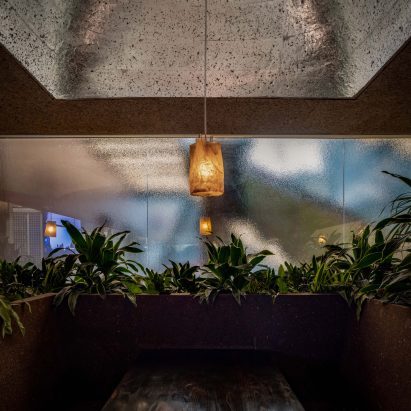
Architecture firm OMA has unveiled Oberon, an all-day bar and restaurant housed within its newly completed extension to the New Museum in Manhattan. The restaurant sits adjacent to the lobby in OMA's addition to the SANAA-designed original building, presenting itself as what the studio calls a "jewel box" wrapped entirely in cork.
The material choice reflects a design philosophy of subtlety and integration. Cork, warm and organic, allows Oberon to exist "hidden in plain sight" within the museum's public spaces. Rather than asserting itself as a separate commercial venture, the restaurant dissolves into the fabric of the institution, treating dining as a continuous experience for visitors moving through the expanded building.
OMA's expansion represents a significant moment for the New Museum, one of New York's most prominent contemporary art institutions. The Dutch firm, led by Rem Koolhaas, has shaped some of the world's most influential cultural buildings. This Manhattan project joins a growing roster of restaurant designs by architecture practices typically known for institutional and residential work. The shift reflects how contemporary museums increasingly view food service not as ancillary but as integral to the visitor experience.
Oberon's opening follows months after the extension's completion, suggesting a careful integration process. The restaurant's positioning within the expansion's lower floors creates a natural gathering point before or after gallery visits, blurring conventional boundaries between consumption and culture.
The cork cladding represents both material restraint and considered aesthetics. It absorbs sound, creates warmth, and resists the sterility that often characterizes museum dining. For OMA, the choice speaks to an approach where architecture amplifies rather than dominates the spaces people inhabit. In a city saturated with destination restaurants and cultural institutions competing for attention, Oberon's deliberate understatement offers a counterpoint: a place designed to enhance the museum experience rather than overshadow it.