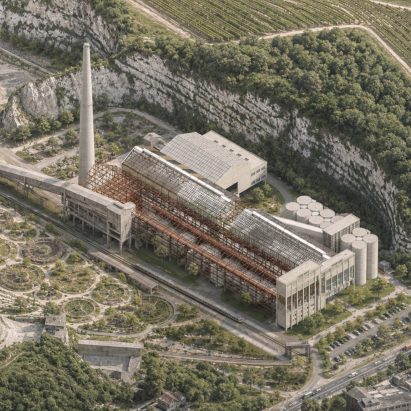
The University of Portsmouth's School of Architecture, Art and Design has unveiled ambitious adaptive reuse projects that reimagine industrial and marginal spaces. The standout proposal transforms an abandoned cement factory in the South Downs into a winery and cultural hub, tackling both preservation and community placemaking in a single intervention.
The project lineup reflects contemporary architecture's growing engagement with sustainability and social responsibility. Beyond the winery conversion, students designed an observation deck constructed from discarded maritime materials, demonstrating how waste streams become design assets. A third scheme addresses housing precarity through a community-driven residential complex in Berlin targeting marginalised populations.
These Dezeen School Shows submissions position Portsmouth among British architecture programs grappling seriously with adaptive reuse. The cement factory project particularly resonates within current discourse around rural revitalization and heritage conservation. Converting industrial sites into cultural anchors has become standard practice across Europe, yet the South Downs location adds regional specificity. The winery model combines tourism, cultural programming, and economic sustainability in ways that serve both preservation and local communities.
The maritime materials observation deck signals another trend: circularity as core design principle rather than afterthought. Rather than rhetorical gestures toward sustainability, the project embeds waste reduction into spatial experience. Visitors inhabit architecture literally composed of discarded materials, making environmental consciousness embodied rather than aspirational.
The Berlin housing project extends this social focus, channeling design expertise toward vulnerable populations often excluded from architectural discourse. These three works collectively argue that schools of architecture bear responsibility beyond aesthetic innovation. They showcase how emerging practitioners approach urgent contemporary problems: rural economic decline, material waste, and housing inequality.
The University of Portsmouth's projects join a broader student-led movement redefining what counts as significant architectural work. Rather than signature buildings or prestige commissions, these proposals measure success through community impact and resource consciousness.