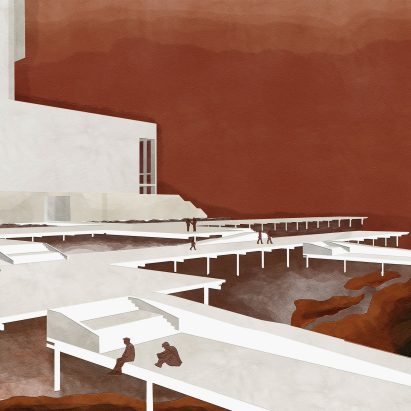
Elisava, the Barcelona school of design and engineering, has showcased student work that includes the adaptive reuse of a former thermal power plant north of the city. The project, presented through painterly visualizations, transforms the seaside industrial site into a new purpose, exemplifying the growing trend of repurposing defunct infrastructure as cities grapple with urban density and sustainability concerns.
The student portfolio extends beyond the power plant intervention. Other notable projects feature furniture that employs taut cables as structural and aesthetic elements, along with a modular system combining ceramic and wood objects designed for urban micro-spaces. This focus on modularity and material experimentation reflects contemporary design pedagogy's emphasis on flexible, scalable solutions for compact living environments.
Elisava's inclusion in Dezeen's School Shows highlights the school's position within Europe's design education landscape. The platform provides emerging designers visibility in the international press while signaling where architectural and design thinking is headed. The power plant project specifically taps into a well-established movement in adaptive reuse, where post-industrial sites become cultural or residential hubs rather than remaining as urban blight.
Barcelona's industrial heritage offers particular richness for such interventions. The city's 20th-century manufacturing infrastructure, concentrated along its waterfront and outlying areas, presents both challenges and opportunities for reimagining. Student projects that engage with this legacy demonstrate how design education can contribute practical solutions to real urban problems while pushing aesthetic and functional boundaries.
The emphasis on modular, space-conscious design reflects market realities in European cities where housing costs and land scarcity dominate planning conversations. Elisava's students appear to be developing work that acknowledges these constraints while maintaining design rigor, producing objects and spaces that address contemporary urban living rather than indulging in purely formal exercises.