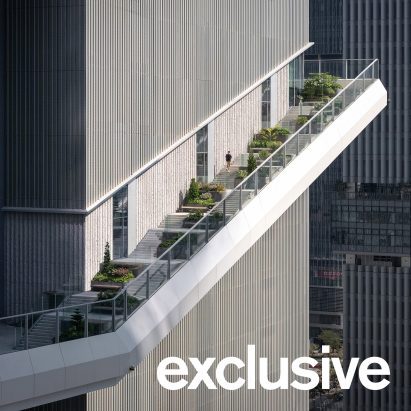
Kohn Pedersen Fox Associates has completed a striking mixed-use tower complex for tech company TP-Link in Shenzhen that reimagines how corporate campuses integrate landscape and built form. The TP-Link LXD development wraps a one-kilometer-long "landscape ribbon" of terraces and planted staircases around three interconnected buildings totaling 124,600 square meters of office, research and development, and residential space.
The design solution addresses a persistent challenge in dense urban environments. TP-Link needed to maximize programmatic capacity on a constrained site while delivering meaningful green space and employee amenities. KPF's response spirals verdant planted zones continuously around the trio of towers, creating visual breaks and environmental relief that conventional setbacks or rooftop gardens alone could not achieve.
This approach reflects a broader shift in corporate real estate strategy. Technology companies increasingly view workplace amenities as retention tools and productivity drivers. Companies like Apple, Google, and Meta have invested heavily in campuses that blur boundaries between work, recreation, and nature. TP-Link's Shenzhen headquarters adopts similar philosophy through landscape integration rather than sprawling horizontal footprints.
The terraced strategy also addresses Shenzhen's subtropical climate. Layered vegetation provides natural cooling, reduces heat island effects, and manages stormwater runoff. The planted staircases double as public circulation and gathering zones, potentially improving wayfinding and social interaction within the 124,600-square-meter footprint.
KPF, headquartered in New York with offices across multiple continents, has built considerable expertise in high-density Asian markets. The firm has designed landmarks in Hong Kong, Tokyo, and Singapore that grapple with similar constraints of limited land and soaring real estate costs. The TP-Link project extends that vocabulary by treating landscape not as discrete amenity but as woven architectural element.
The completion signals momentum in China's corporate real estate market even amid economic headwinds. Tech companies continue investing in flagship facilities that signal stability and attract talent. TP-Link's ambitious campus suggests confidence in both Sh