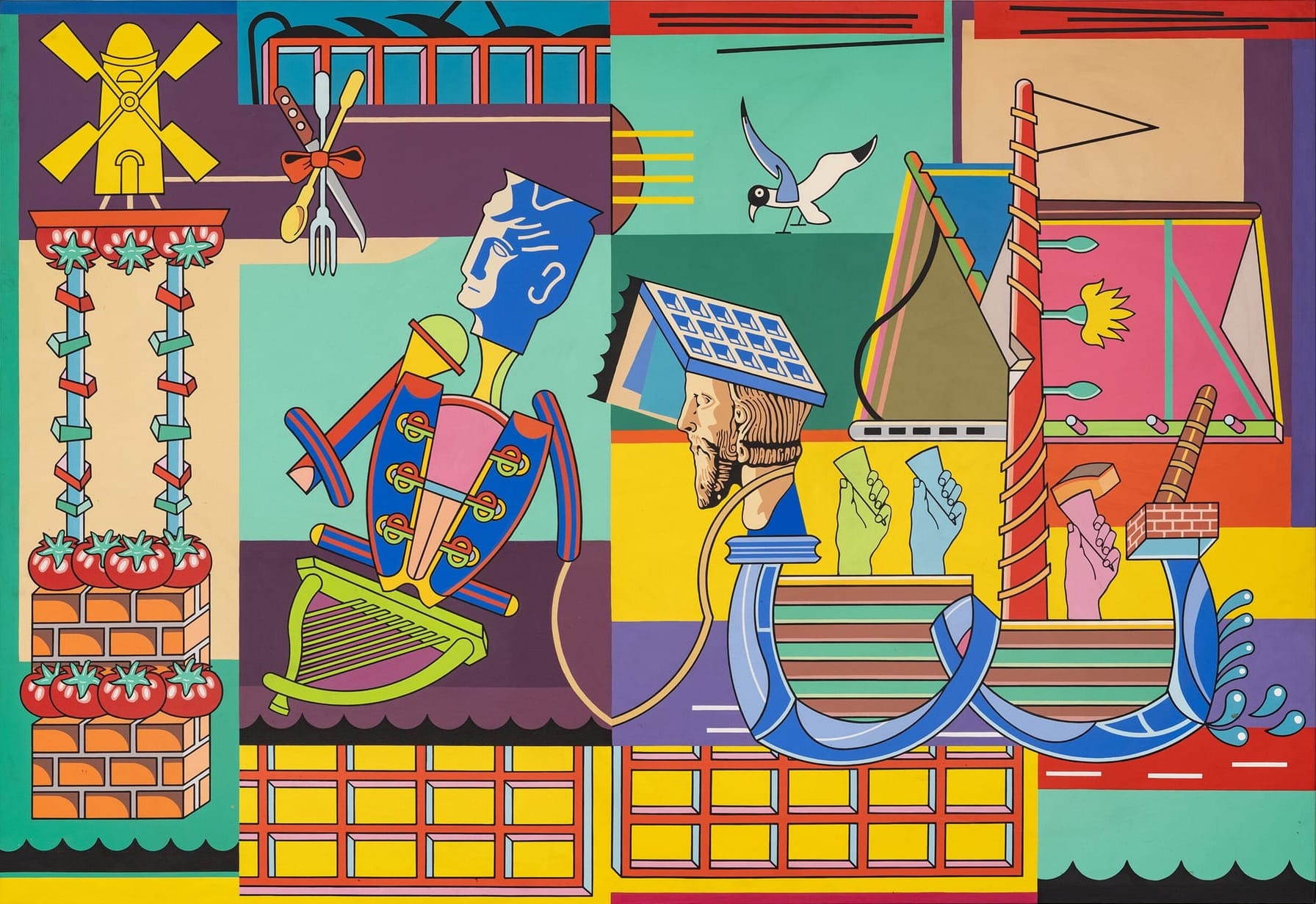
Trevor Winkfield creates visual worlds that resist easy interpretation. The artist's practice embraces ambiguity and formal playfulness, constructing scenes where logic breaks down and meaning becomes unstable. This approach stands as a deliberate counter to art that demands clarity or singular readings.
Winkfield's work engages viewers in active interpretation rather than passive consumption. His compositions layer symbolic elements, surreal spatial relationships, and unexpected juxtapositions that force reconsideration of how we read visual information. The cheerfulness of his palette and composition contrasts with the underlying disquiet of his imagery, creating productive tension between surface appeal and deeper unease.
In an art world increasingly driven by market demands for legible narratives and instantly recognizable styles, Winkfield's commitment to opacity becomes radical. He refuses the contemporary pressure toward explanation and artist statements that solve interpretive puzzles for audiences. His rejection of certainty extends beyond individual works to encompass a broader philosophy about imagination's role in artistic practice.
This stance arrives at a moment when institutional art often prioritizes accessible messaging and measurable impact. Winkfield insists that ambiguity itself holds value. Not knowing what something means, or encountering multiple competing meanings simultaneously, activates the imagination in ways that certainty cannot. The viewer becomes a necessary collaborator in meaning-making rather than a passive recipient of predetermined messages.
His cheerfully sinister aesthetic resists categorization across media and decades of practice. By maintaining this commitment to imaginative complexity, Winkfield reminds the broader art world that rigor and accessibility need not align. The most urgent artistic practice often operates in discomfort, in spaces where questions outnumber answers and meaning remains deliberately deferred.