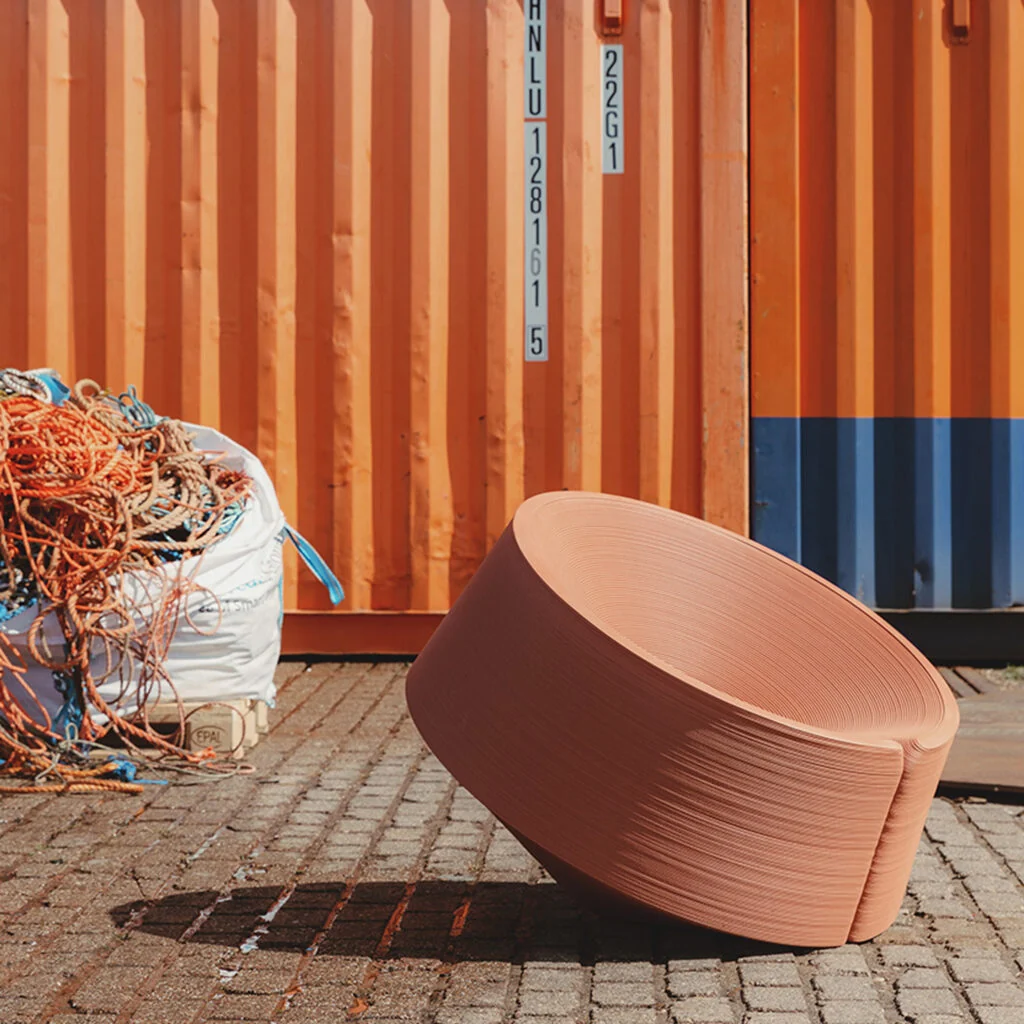
The New Raw, a Rotterdam studio founded by Foteini Setaki and Panos Sakkas, has created a series of 3D-printed stools called Buoy from discarded marine rope salvaged from the city's harbour. The studio collected plastic ropes formerly used for managing boats, transported them to Maastricht for cleaning and shredding, then mechanically recycled them into pellets before 3D-printing the stools back in Rotterdam.
"The material fuses as it is deposited, so no separate binder is needed," Setaki told Dezeen. Marine ropes present recycling challenges because they contain multiple materials and accumulated residues, requiring careful selection to identify those with the highest polypropylene content.
No virgin plastic appears in the stools, though a small percentage of additives including UV protection support outdoor durability. "These additives are compatible with recycling the material again," Setaki said. Each seat displays a subtly different hue determined by the original rope's colour rather than added pigments.
The stools feature spinning top-style pointed bases designed to rock when users sit down, mimicking buoys bobbing on water. "We wanted the seats to carry a recognisable link to their maritime origin, through both their shape and the slow movement of floating buoys," Setaki explained. "Borrowing that movement brings a playful quality to sitting, and the connection to the harbour becomes something you can feel."
Each stool was engraved with batch and production numbers, then placed by Rotterdam harbour. Setaki noted the project strengthens "the relationship between the city and its harbour," adding that "this approach could also be adapted to other harbour cities, starting with their own discarded materials and local networks."
Buoy is shortlisted for a 2026 Dezeen Award in the sustainable design category alongside projects including a cement-free architectural material made from waste date pits and lighting created from faulty publications.