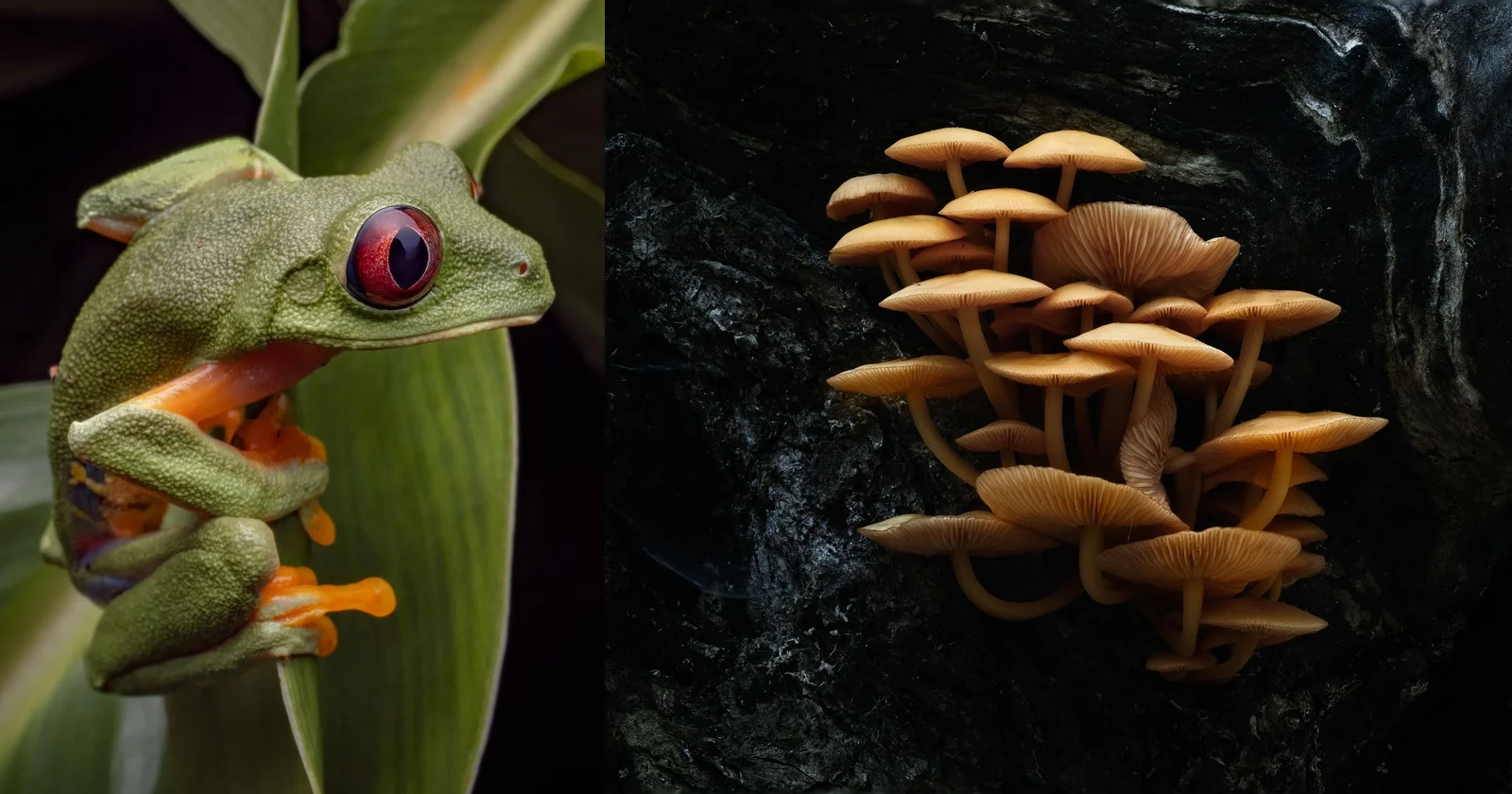
Peter Baumgarten stands six feet two inches tall, tall enough to walk past the entire miniature world beneath his feet without ever noticing it exists. Yet on the forest floor of McLean's Park on Ontario's Manitoulin Island, where he regularly walks his dog, centimeter-tall mushrooms and garden slugs perform an elaborate drama that demands to be witnessed—if only someone will get low enough to see it. The problem isn't that these subjects lack beauty or significance; it's that we've built our lives at eye level, training ourselves to ignore the extraordinary ecosystems thriving just inches from our path.
The photographers profiled in this account—Baumgarten, Lisa and Tom Cuchara, and Chris McGinnis—have learned something crucial about observation: the most compelling stories in nature often unfold in spaces most people walk past. When Lisa Cuchara ventured into her Northeast garden after dark, she discovered a bright green hornworm covered in white cocoons—the silken work of parasitoid wasps developing inside the living caterpillar. As she notes, 'Without a flashlight and a willingness to explore the garden after sunset, I might have walked right past an extraordinary biological story unfolding just inches away.' This wasn't merely an interesting photograph; it was nature's own pest control system at work, a Cotesia species species keeping hornworm populations in check for gardeners who despise the creatures.
What these photographers understand is that macro photography serves a purpose beyond technical achievement. Baumgarten captures mushrooms and slugs as a form of meditation, a way to 'get out of a rut' when his landscape and wildlife work stagnates. He explores McLean's Park several times a week because, as he explains, 'macro subjects are everywhere, and a local park or garden can be a great place to start looking.' The geometry of mushrooms and their infinite patience make them ideal subjects for newcomers to macro photography—they won't run away as you compose your shot, won't demand the split-second timing that wildlife requires.
Yet there's a deeper lesson here about cultural attention. We invest billions in photography equipment and technology while remaining largely blind to the miniature dramas happening in parks fifteen minutes from our homes. The Cucharas used their OM-1 Mark II and focus-stacking techniques to capture details that reveal biological relationships we might otherwise never recognize. Baumgarten's advice—to explore one or two days after rain, to avoid bright sunny days—represents practical wisdom about patience and timing that extends far beyond photography.
The real question isn't whether macro photography is worth pursuing. It's whether we're willing to fundamentally change how we move through the world. To get low on the forest floor. To carry a flashlight into the garden after sunset. To believe that extraordinary stories are unfolding right now, everywhere, waiting only for someone curious enough to stop and look.