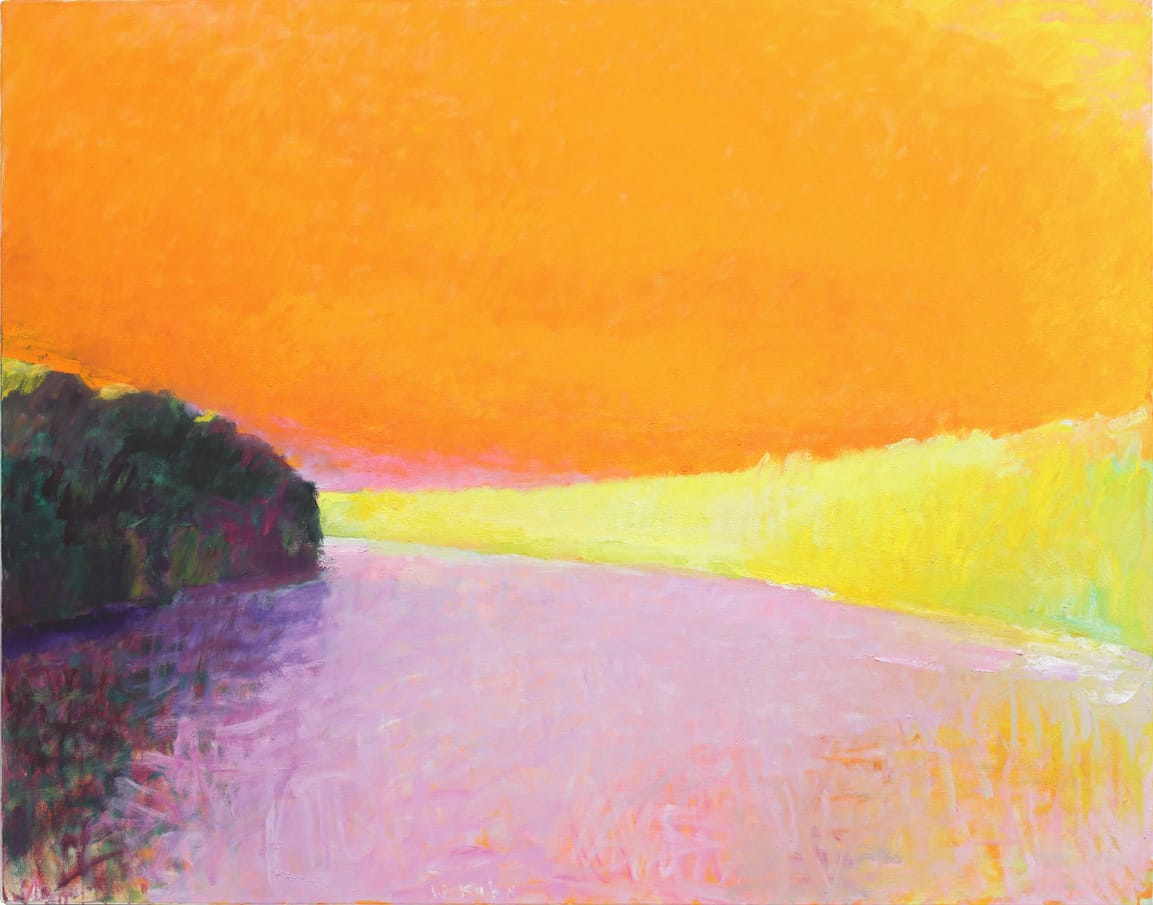
Next October marks Wolf Kahn's 100th birthday, and seven museums across Germany, New York, and Vermont are preparing to honor the late abstract landscape painter with exhibitions throughout 2027. It is a fitting tribute, assembled by the artist's namesake foundation, which recently opened a permanent location for its archives in New York City this summer. Yet as these institutions prepare their presentations, they have an obligation to ensure that Kahn's story—particularly his trajectory as a Jewish refugee who fled Nazi Germany in 1940—remains central to how we understand his artistic vision.
Kahn's biography is inseparable from his art. Born in 1927 in Germany, he arrived in the United States as a refugee during World War II, eventually establishing himself in New York City, which became an influential home base throughout his lifetime. His displacement and survival shaped not merely his personal resilience but his artistic sensibility. The luminous, exaggerated, and arbitrary color he became known for—those glowing effects across his landscapes—emerged from someone who had witnessed darkness and chosen to render the world in saturated hues and diffused light.
The geographic scope of these centennial exhibitions is meaningful. Venues in the country of his birth, alongside locations in New York and Vermont where he developed his practice, create an opportunity to trace how place and belonging informed Kahn's work. He spent formative years in Provincetown, Massachusetts, working as a studio assistant for Abstract Expressionist Hans Hofmann, before purchasing a farm in West Brattleboro, Vermont, where he painted en plein air from 1968 until his death in 2020. Over seven decades, Kahn carved out a reputation for melding the representational with the abstract, rendering nature through a distinctly personal vocabulary of color and light.
As these museums prepare exhibitions of Kahn's reputed, lesser-known, and never-before-seen work, they should resist the impulse to aestheticize his refugee experience into mere biographical color. Instead, they must ask how that early displacement and loss shaped an artist who spent fifty-two years in Vermont painting the American landscape with the eye of someone who understood the fragility of home. The centennial celebrations should illuminate not just Kahn's technical innovations, but the profound humanism embedded in his choice to render the world in such radiant, generous color.
Wolf Kahn's centennial offers museums a rare opportunity to show how art, memory, and belonging intersect. His story—a Jewish boy who fled Nazi Europe and found solace in the pastoral American landscape—is precisely the kind of narrative that museums should amplify with clarity and depth. These seven institutions should ensure that Kahn's centennial celebrations honor not only his artistic legacy, but the resilience and vision of a refugee artist who transformed personal loss into luminous beauty.